Buying guide
Floor Spring vs Hydraulic Patch Fitting for Glass Doors
Short answer: Use a floor spring when the floor can be cut and the door is heavy or heavily used. Use a hydraulic patch fitting when the floor is finished or cannot be cut, for example in renovations, because the closing mechanism sits inside the bottom patch.
How each one works
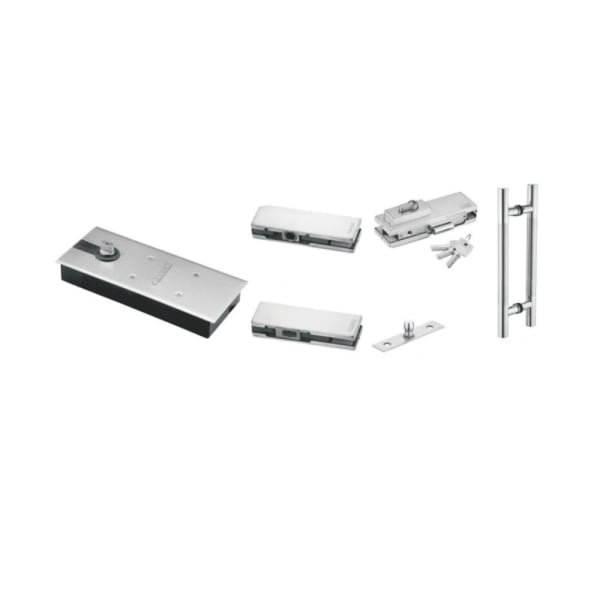
A floor spring is a hydraulic closer in a steel box set into a pocket cut in the floor. The door's bottom patch sits on its spindle. A hydraulic patch fitting builds the closing mechanism into the bottom patch itself, so nothing goes into the floor except a small pivot.
Comparison
- Floor cutting: a floor spring needs a pocket cut; a hydraulic patch needs almost none.
- Best for: floor springs suit new construction and heavy, busy doors; hydraulic patches suit renovations and finished stone or tile floors.
- Capacity: Glassics floor springs are rated to 90 kg (GSR-6001) and 130 kg (GSR-6000).
- Installation: a hydraulic patch is usually faster to install on a finished site.
How to estimate door weight
Toughened glass weighs about 2.5 kg per square metre for every millimetre of thickness. A 1.0 m × 2.1 m door is 2.1 m². In 12 mm glass that is 2.1 × 12 × 2.5 ≈ 63 kg, before handles and fittings. Choose hardware rated comfortably above that figure.
Buying as a kit
Both options come as combo sets with matching patches, so the installer receives a complete door kit.
Published by Glassics · Updated 2026-10-02